When people talk about digital marketing, the conversation usually revolves around three goals: generating more leads, converting those leads, and increasing customer lifetime value. All important, but before deciding on a digital marketing strategy, we first need to map out how a business acquires new customers.
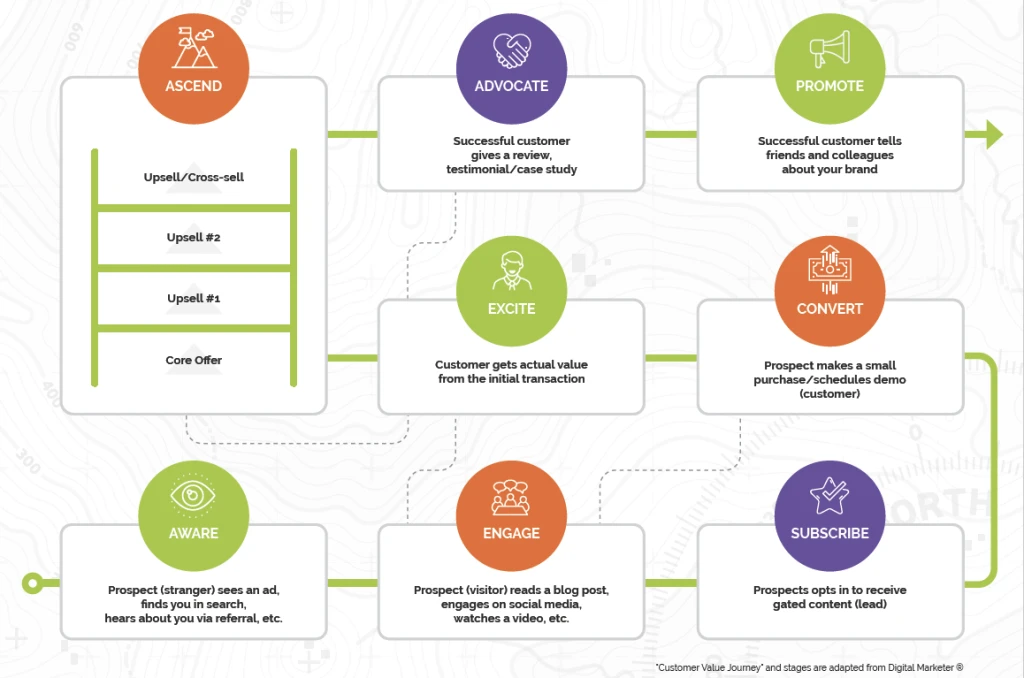
That’s where the customer value journey comes in. It’s a simple way to map out the relationship between a brand and a customer, from the very first touchpoint to long-term loyalty.
The stages of the customer value journey
Aware
The customer discovers your brand for the first time.Engage
They interact with your content and start paying attention to what you do.Subscribe
They opt in—by following you, joining your newsletter, or giving you their email. This is the moment the relationship becomes more direct.Convert
They take action and become a customer, usually through a first purchase or commitment.Excite
You deliver a strong initial experience that meets or exceeds expectations.Ascend
They buy again, upgrade, or invest more because they trust you.Advocate
They recommend your brand to others.Promote
They actively share your brand through reviews, referrals, or content.
A common mistake I see is trying to rush the journey and skip stages. For example, many companies attempt to jump straight from aware to ascend and push sales before trust has been built.
The result? Lower conversion rates, higher churn, and customers who never fully believe in the product.
What does it actually look like?
To make this more concrete, I mapped out a customer value journey for a marketing agency. In this example, we (the company) primarily offers paid advertising services.
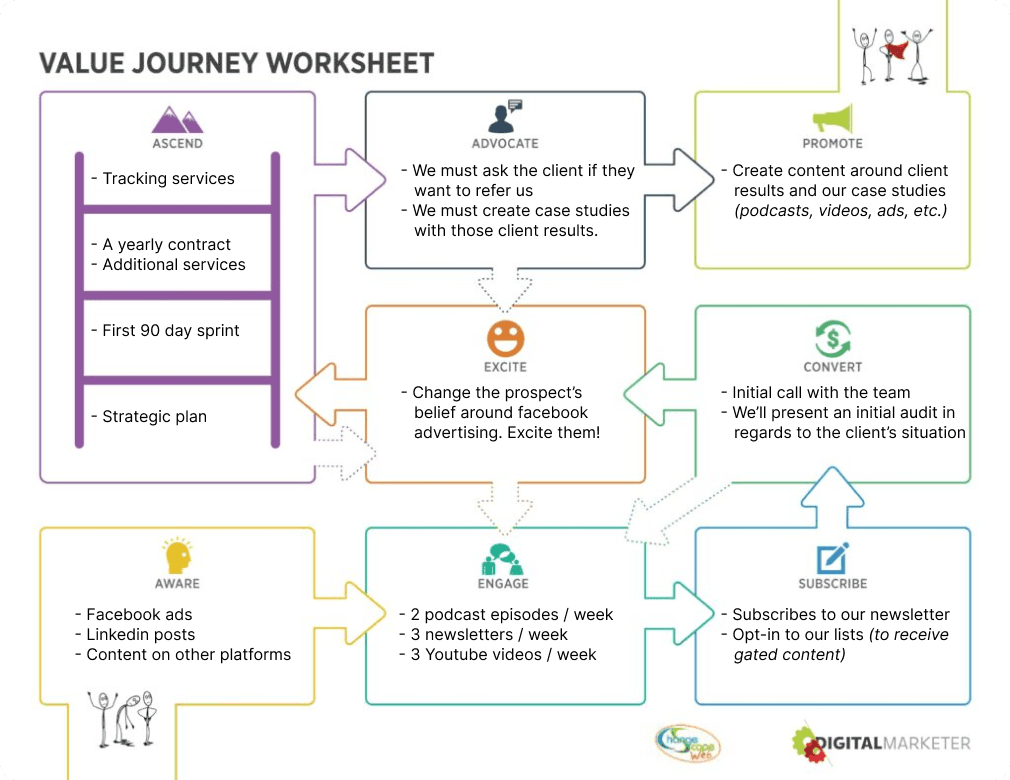
*Access the Figma file: https://www.figma.com/community/file/1596224606194516353
Here’s how the journey plays out:
Prospects find out about us through organic and paid content.
They like and engage with that content.
They provide their contact information to receive more value from us.
Ideas: best ad hooks, ad templates, Meta budget calculator, newsletter, etc.
They convert on an initial call with the team or when we present their audit to them.
Excite: We must change their belief around our service. They should feel excited and happy after purchasing our service.
We then move them up the value ladder little by little, increasing the price as they trust us to deliver.
We must ask them for references. People rarely do that on their own.
We must then create more content around our case studies, which will lead more people to become aware and start the cycle again.
Final thoughts
At the end of the day, the customer value journey is simply a way to understand how people come to trust a brand. When you take the time to help customers move from one stage to the next, things start to fall into place. Acquisition improves, retention gets stronger, and you build a brand that people genuinely connect with.